
(Continued from Part 1, which looked at the state of TTRPG dungeon design pre-Jaquays. These two posts are cleaned up versions of my two Bluesky threads on the subject.)
In Part 1, we reviewed early kinds of dungeon design philosophy that you can still see in modern dungeon writing. The earliest pre-made dungeon level, which came with OD&D’s Underworld and Wilderness Adventures, focused primarily on movement through corridors and mapping the twists and turns to provide an interesting expedition for the player characters. Stuff like Temple of the Frog aimed for a more organic feel, laying out the dungeon as a real location in the world with its own internal logic. As the 70s went on, we started to see more bridging of the idea of the “mythic underworld” with more logical, setting-consistent level design (see my semi joking thread about Sun Tzu’s three varieties of dungeons). We also some early attempts at dungeon context: back stories for the locations, motivations for the inhabitants, custom wandering monster tables and the like.
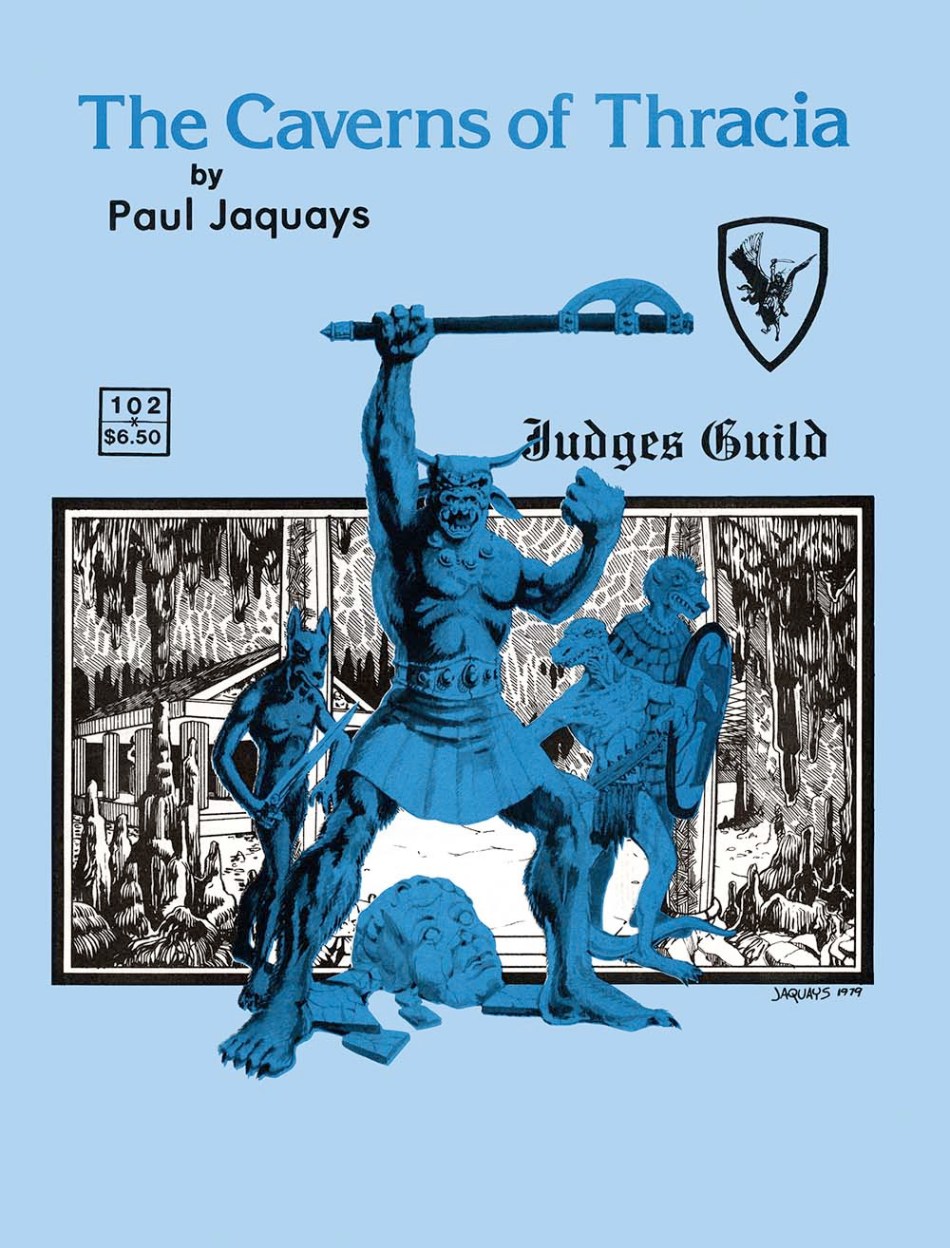
However, it was arguably not until the topic of this post that we got a pre-written dungeon that gave us a multilevel, fully keyed dungeon that integrated all of these ideas in a sophisticated whole, the earliest (that I know of) example of substantive dungeon design someone could point to and say “do it like this.” That, of course, is Jennell Jaquays’s The Caverns of Thracia. Let’s get right into it.
Front Matter
Like Gygax’s modules before it, Thracia positions itself as a teaching text. It contains annotations and GM advice right in the room keys, and gives some insight into how it’s designed to accommodate multiple kinds of campaign worlds. That said, while Thracia is a teaching tool, it is quite complete, especially compared to what we’d seen before this.
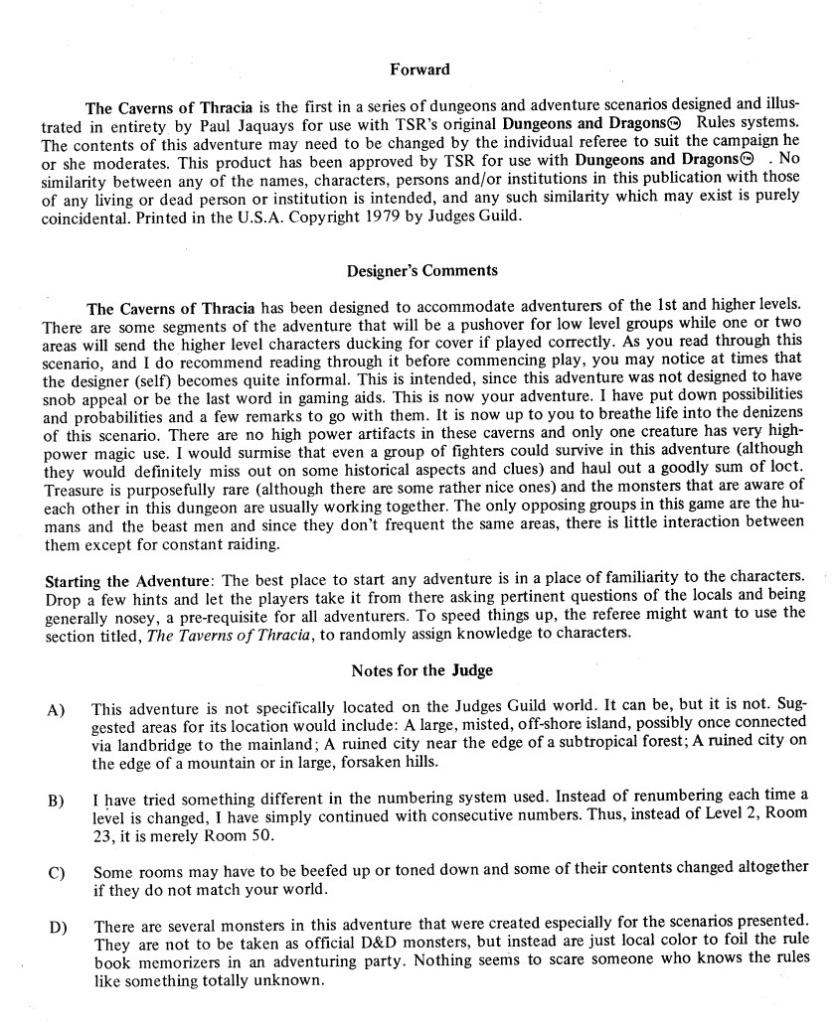
The background info facially seems much like what we’d seen before in Temple of the Frog and Palace of the Vampire Queen, but strikes a middle ground between Vampire Queen‘s terse set up focusing on externally available information (i.e. things the players might hear as rumors) and Temple of the Frog‘s detailed history and faction information. The result is something only a bit longer than Vampire Queen‘s background text, but which tells us a lot of immediately gameable info — we learn who controls what and why, and why the two groups are fighting for control of the same area. Take a look at this excerpt below:
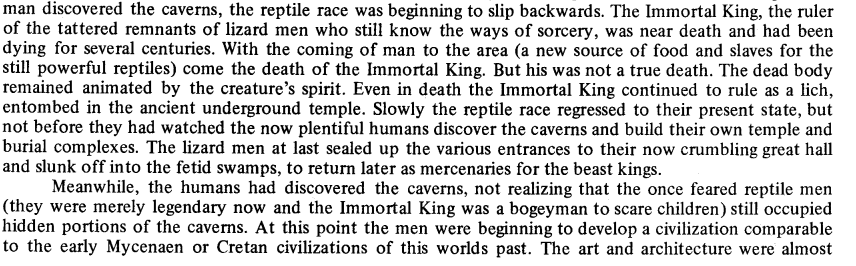

This is perhaps looking further back in time than I usually care to as a GM, but I can’t deny that this is highly useful information to actually running the dungeon. We get a sense of the value and superstitions attached to to the caverns by the three main factions, as well as which levels were originally built by whom in what cultural analogue. We also see that the beast men (one of the two major factions) revolted against the humans a long time ago, giving some context to what kind of narrative drives these two cultures to war in the present. Right after this we get to a quick description of who controls each floor in the present:
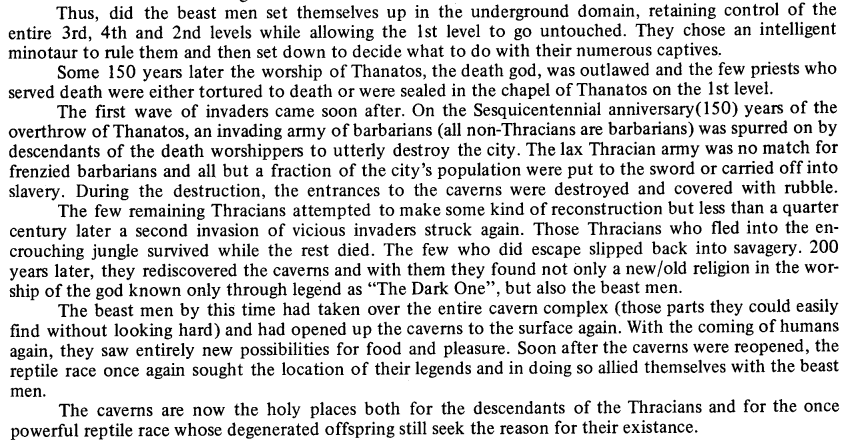
One might think that the text after those first couple paragraphs is pure flavor, but it’s actually pretty relevant to running this dungeon. Combining the info about the current situation with the backstory excerpt above, we know that the beastmen control the 2nd level, which includes a temple previously built by Mycenaen and Cretan-analogous human cultures. We also know that the Thracian descendants who now vie for control of the upper levels see this as a holy ground, but apparently don’t actually know much about this place or the history of its religion due to being cut off from their older culture. Finally, we know why this situation has remained a powder keg for this long, despite the humans being an obviously weaker faction — the beastmen see some benefit in keeping them around, even if they’re enemies. So now not only do we have a good idea of the factional control of the various levels of the dungeon, but we have at least two layers of history to each part of the dungeon — what it used to be and what it is now.
This idea of layered history would become a tried and true strategy for modern dungeon design, as it allows for a diverse set of NPCs to interact with who are themselves not totally at home in the places they now control. It also means most rooms get to have contextual layers to them, with an original use and a new one at the convenience of its current inhabitants. Thracia takes it a bit further here in giving us layers of history the players may never interact with, e.g. you have a situation where human tribes seek to control a beastmen-controlled temple that was originally built by culturally different humans which may in turn have been inspired by the original reptilian ruler. While modern takes on this might simplify this lineage of the dungeon a bit, I think we still tend to do roughly what Thracia is doing with this background section. And keep in mind, Thracia is doing this with just over one page of text!
After the backstory, we see that Thracia comes with its own wandering monster tables — previously seen to a degree in The Steading of the Hill Giant Chief — and a short section on restocking the dungeon for subsequent expeditions which I don’t think has shown up in a module up to this point. The judicious use and keeping of time in OD&D is a core element to its challenge, and these tables accommodate this.
Notice in the excerpt below that there is no vague assertion that the situation should change each time the players exit the dungeon. Instead we get solid, specific advice on tracking notable characters across encounters and when and why some rooms might feature monsters on later visits.
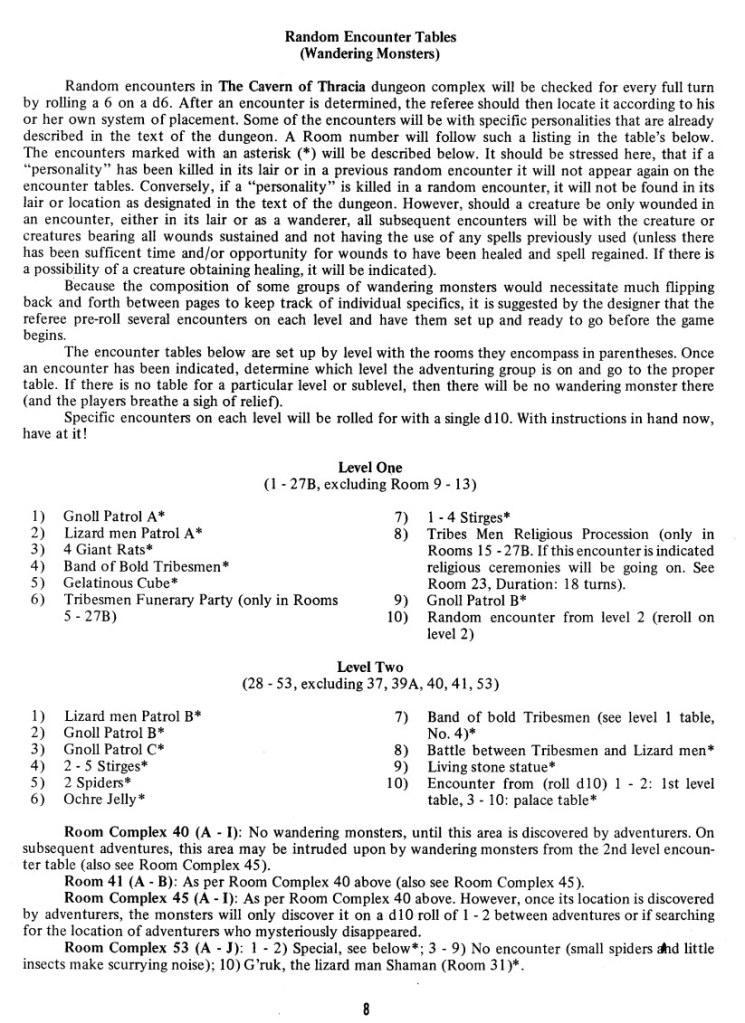
Not only is there a wandering monster table just for this dungeon, each encounter is keyed! Beyond that, these encounters are logically tied to factions you will later encounter. Already we can see how Jaquays is subtly blending storytelling and tactical challenges:
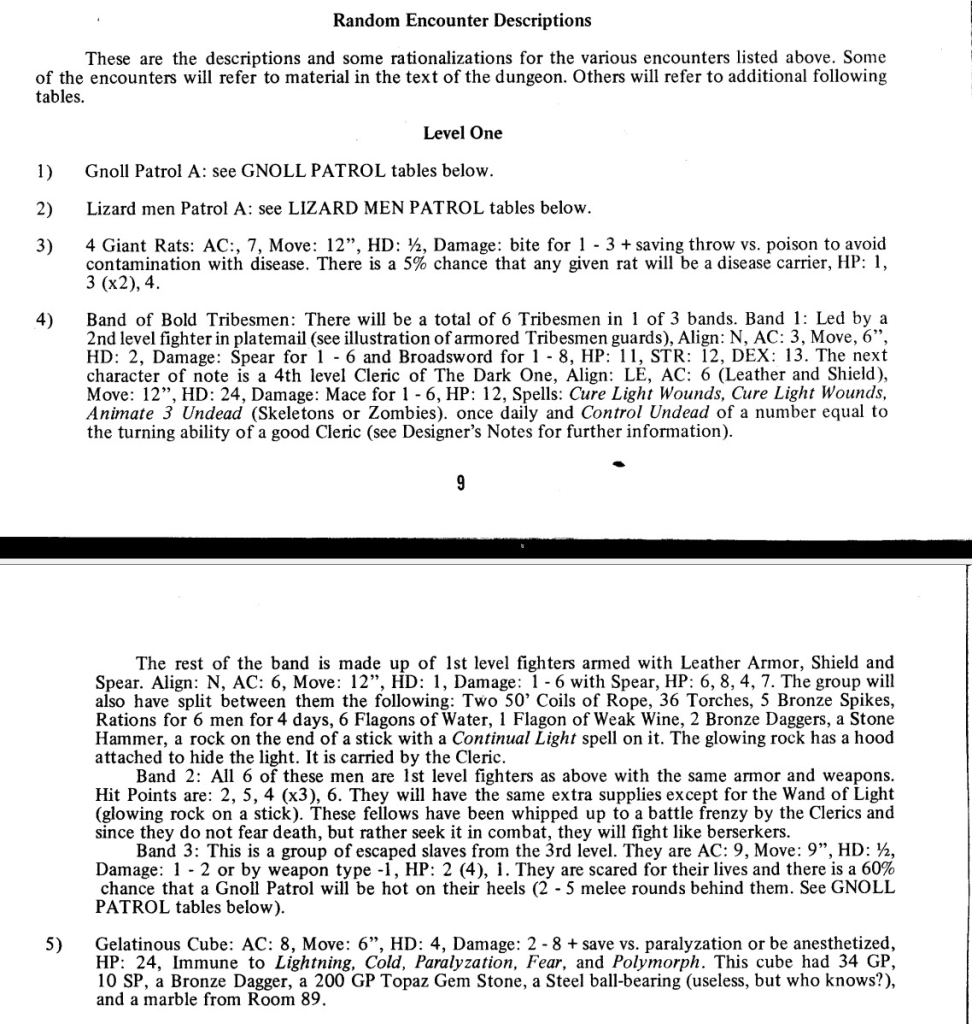
As an example, check this dryad encounter out. This encounter, which produces one of ten specific characters who can show up in the actual key, ties in to an ongoing situation on the third dungeon level and is designed to possibly change each time the players encounter it. There are even roleplaying motivations and hidden allegiances to work with! We’re already seeing layered, multipurpose design and we’re still in the pre-dungeon matter.
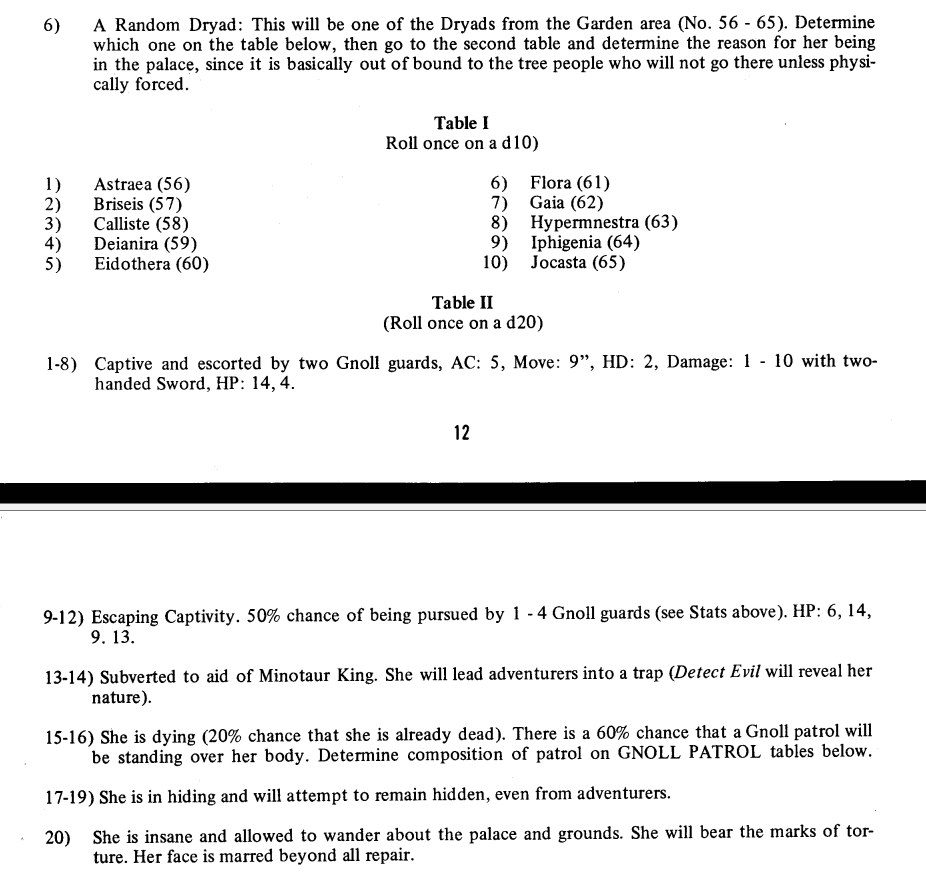
I want to shout out a couple more encounters in this section. In #8 below we get to see the factions in open conflict, with strong guidance on what happens if the players don’t intervene. I love how this encounter references specific bands that could be encountered elsewhere, as the Tribesmen are from a specific encounter on level 1, and the Lizard Men are from a patrol that can show up on any level.

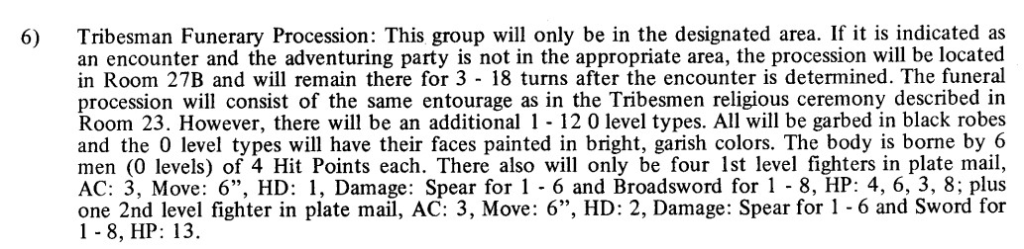
I should also point out that #6 also does something pretty interesting. It’s an encounter that does not come to where the party is. Instead, the GM is supposed to place the encounter somewhere in the dungeon in case the players go there. I don’t think this kind of thing will appeal to all GMs due to the extra tracking, but I like that Thracia features this as a special circumstance. There will be times when players come to one of the rooms this can occur in and see a procession where there was not one before, even though they didn’t roll an encounter. Nowadays this would be done via a schedule or a die roll listed per room, but the idea is essentially the same.
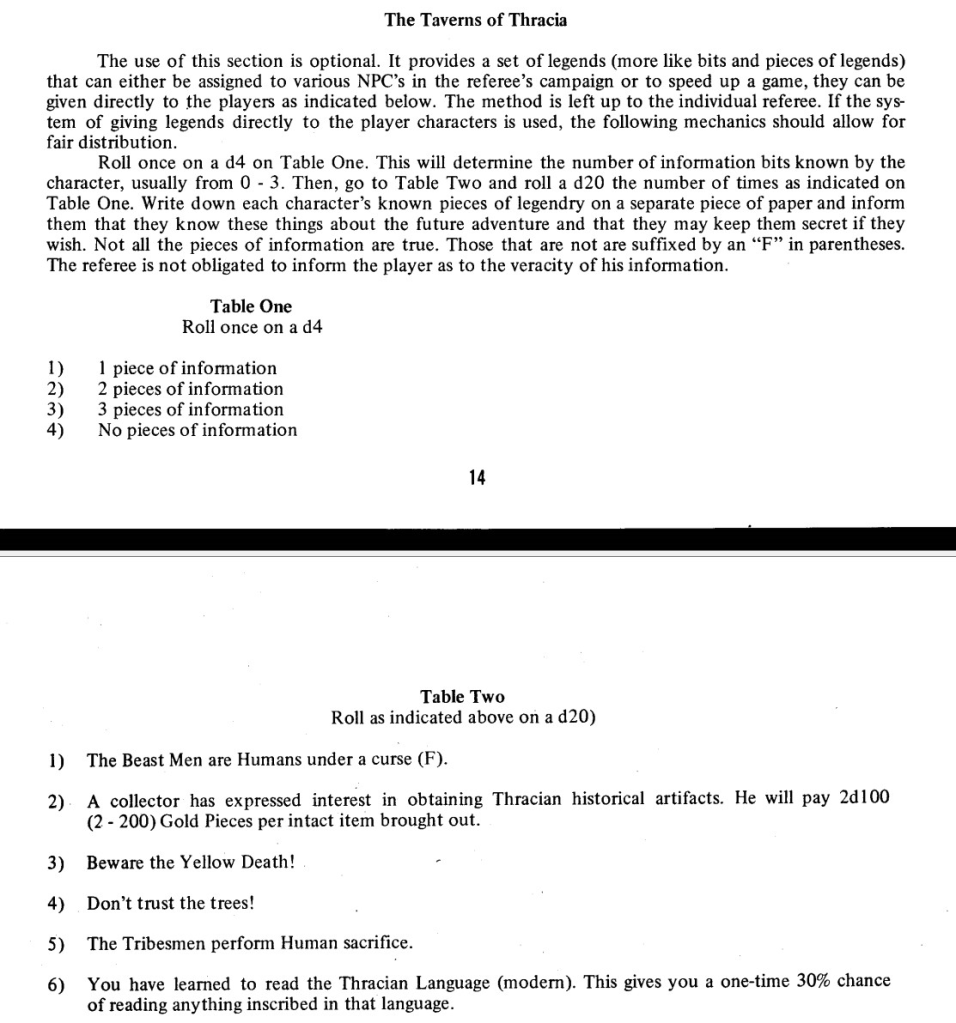
If this next bit existed before Thracia, it was rare: rumor tables and procedures to give the players objectives, info and plot hooks about the dungeon. Obviously pretty common practice now, but as far as I have seen in the modules I’ve read leading up to this, they’ve just told the GM what the players know before entering the adventure site. As much as I sound like a broken record here, it’s yet another example of how much Jaquays focused on creating dynamic player interactions with the dungeon. Every party that enters Thracia is going in armed with different information.
I love, by the way, that Jaquays includes learning whole ass local languages as part of the rumor table. There are also the always-controversial false rumors included here, which I only note because I find it interesting that Jaquays was exploring so much design space with this rumor table even though its very inclusion was not standard practice at this point in time.
The Dungeon Exterior
With the pre-dungeon matter out of the way, let’s get into the actual keyed locations, starting with the exterior. This dungeon has multiple entrances (a key feature of Jaquays’s design praised in Justin Alexander’s article), and they all offer different tactical considerations. The lattices on the map below are the main “city” ruins you enter from:
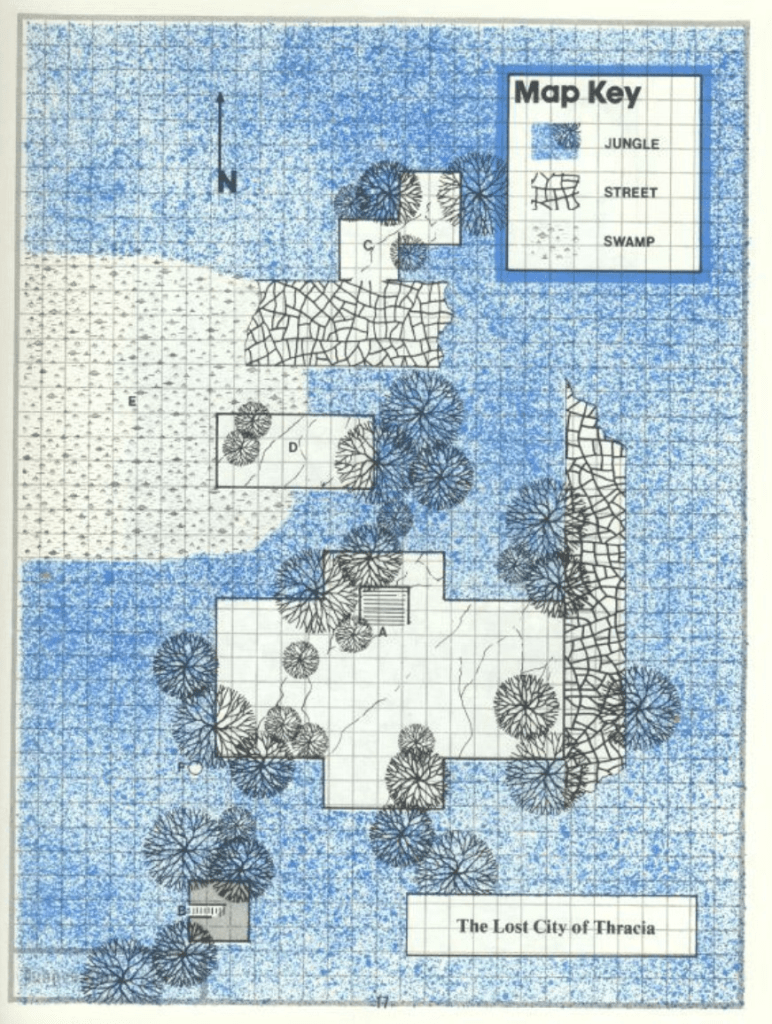
Jaquays does not get much into what can be found in this city, though there are some big benefits to exploring it. I appreciate that the ruins leave quite a lot of open space to add your own content without needing to work very hard to integrate it with the dungeon levels below. I think of this as a kind of precursor to the “Caves of the Unknown” that B2: Keep on the Borderlands instructs you to fill in for yourself, though Keep is much more explicit about this.
Let’s take a look at the city key:
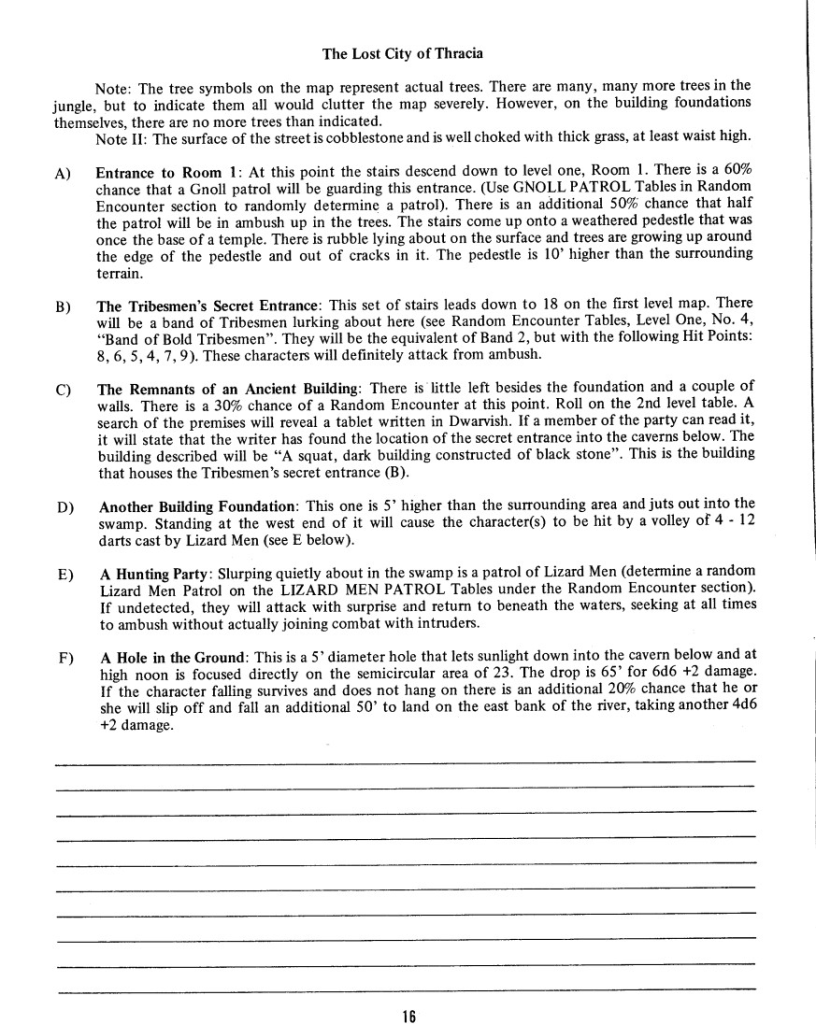
First off, there are three entrances described here, but only one is in an obvious structure. It’s likely guarded by gnolls, possibly waiting in ambush. Another obvious structure has an ambush by Lizard Men, one of the first possible indications of what factions are play in this area. The third obvious structure has a clue telling the players that a second entrance exists and what it could look like. Thus, before the players even enter the dungeon, there is pathing, investigation and factional play happening. The players can learn a lot just by doing something other than walking to the most obvious entrance, and if they play their cards right, their investigation of one of the other structures could lead to safe passage through the human tribesmen entrance (depending on how that encounter goes, of course).
There is pretty strong logic to doing it this way: the second entrance is a secret, more tactically advantageous one. Of course it is jealously guarded by the tribesmen. The main entrance is guarded by a faction in conflict with them — the beast men. And from a game design point of view, it makes sense that the entrance the players are more likely to use safely is potentially a reward for thorough investigation of the area.
Note that both of these entrances are pretty easy to discover from inside, so it’s possible players will be surprised by what they find if they exit the dungeon from these stairways rather than enter it. Just the two “main” entrances alone create chances for discovery that will play out differently for each party.
Let’s talk about the third entrance. Honestly this is one of the coolest things you’ll find in a D&D module for how simple it is:

This one is very different from the others as it’s not known to the caverns’ three main factions, and is not conventionally traveled. The hole leads to an area far from the other entrances, and is unlikely to be discovered above ground. Why? It’s unmarked, not near any of the obvious structures, and is in an area likely patrolled by the Lizard Man hunting party. The players will have a tough time finding this one, though it’s possible if they spend time thoroughly sweeping the area. What’s more likely is that the players will discover this hole from within the dungeon. If they can solve the mapping challenge necessary to link the room the hole leads to with where it’s found above ground, they will have uncovered their own secret entrance, descendible by rope.
This is some Metroid shit and Metroid isn’t coming out until the next decade! Note too that there are unique qualities to taking this exit that make it not a strictly better choice than the others: the players will need to ascend by rope to use it, so while it’s safer, they’re probably not getting a cart of treasure up with them. Game design!
The First Floor
Without further delay, let’s get into the dungeon layout of the first floor. I’m going to get into real nitty gritty detail about floor one, and then talk more abstractly about how the rest of the dungeon iterates on this design. Here’s the map of floor one:
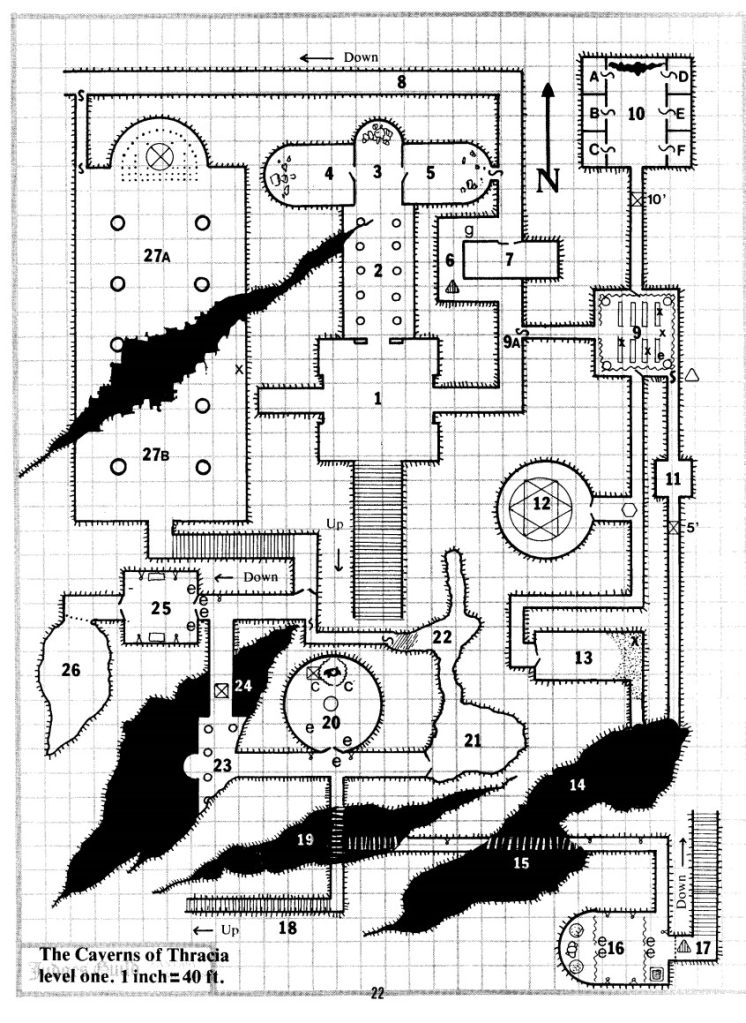
Immediately we can see a synthesis of the styles of dungeon layout we’ve seen up to this point. There are still some windy hallways, but they’re individually keyed and interesting in their own right. There are discrete rooms arranged in small loops like we previously saw in some of the Judges’ Guild maps, though curtailed to a few interesting pathing choices presented at a time rather compared to the rather overwhelming layout of something like Tegel Manor. There are some terminal paths in this layout, but the biggest points of interest have at least two paths to them (though these paths are sometimes windier and more obfuscated than they will be in later floors). Further, the paths are always materially different in the terrain and challenges they pose. In other words, we’ve come a long way from the “left or right door” choices we saw in the shopping mall style layout of Palace of the Vampire Queen.
Let’s look at the very first pathing choices coming from the most obvious entrance from the surface. This gives us a path straight north covered in guano, with possibly a hint of a huge statue of Athena all the way to the back (the key is ambiguous as to whether torches or natural light from the stairway would have the players see this far, but I think it’s plausible to make out at least an outline given the direct sightline). Alternatively, the players can take the winding hallway to the east with no hints to what lay beyond. There’s also a short terminal path west which sure seems to invite some kind of excavation to open a new path to room 27, but the scale of the map indicates this is close to 20 feet of rock.
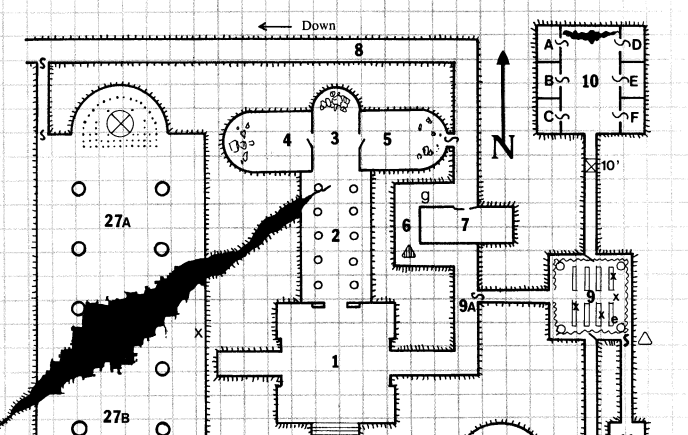
Notice how these two paths technically loop into each other, but only through a secret door between rooms 5 and 7. Otherwise, the players are eventually going to be funneled to 9A, which may take the party to a series of rooms that operate on their own wandering monster table, detailed below:
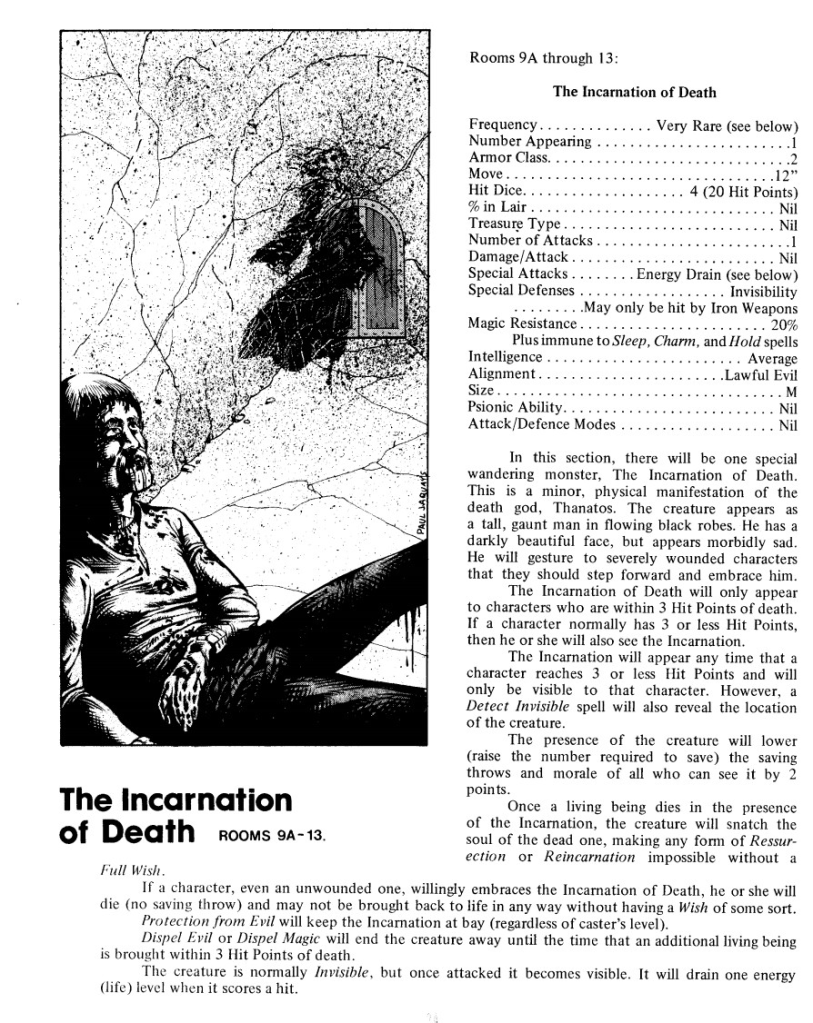
I don’t want to sound like a broken record but there isn’t really anything like this set piece in modules that precede Thracia. Certainly the space is there for the GM to insert these things (or interpret entries on a key this way), but Jaquays really goes the extra mile here to create distinct sections of the dungeon that each carries its own unique interactions without these sections being isolated from each other (like the individual rooms on the hallways of Vampire Queen).
The gimmick here is pretty smart in that it’s not particularly threatening, but will invite a lot of interesting intraparty interactions. It’s likely an OD&D party will have some characters below and above this 3 hit point threshold given that everyone’s using d6s at this point. Thus, you pretty quickly end up with a situation where people in the party are seeing two different things and need to resolve why this is.
Let’s talk a bit about how the rooms of this dungeon are keyed. Thracia is a lot more detailed in how it describes possible interactions with the environment than basically anything we’ve seen before. Some of it stems from the inclusion of practical GM advice alongside room descriptions, but much of it is that the rooms simply have a lot going on. Some examples:
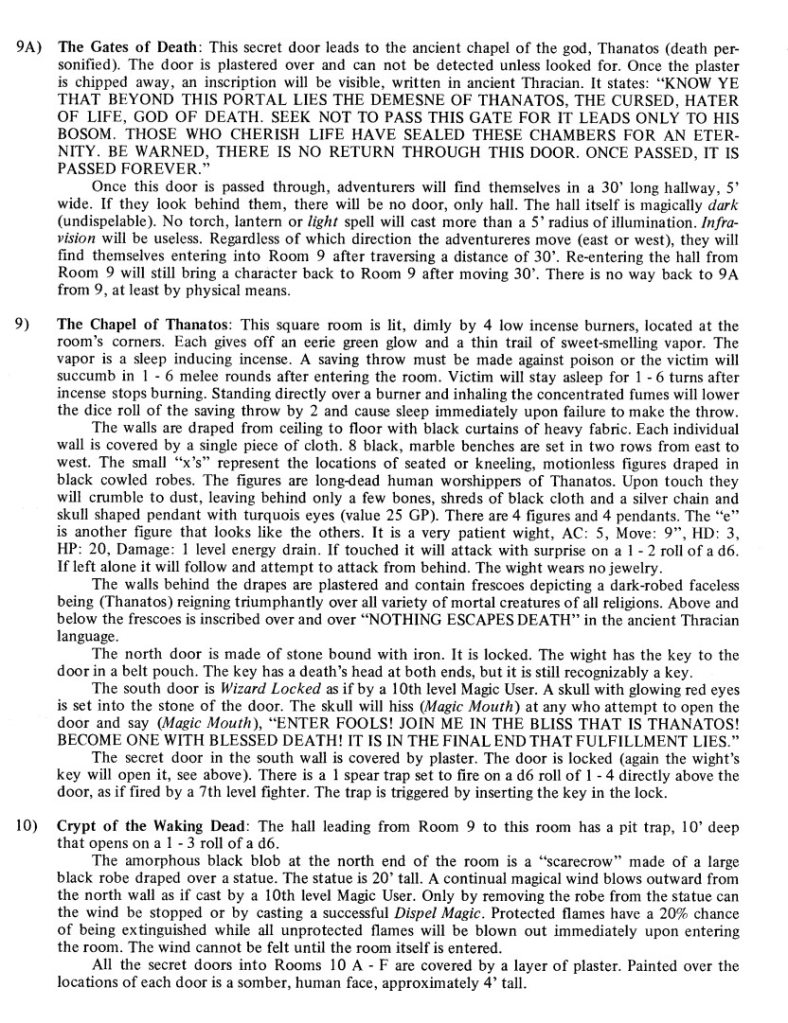
I should note that this level of verbose keying with elaborate room descriptions, ceremonies, etc. is not an invention of Jaquays; at least a hint of this was seen before in Arnesons’s Temple of the Frog. I think what Jaquays is doing here is notable because it combines the descriptions of realistic places and people seen in the Frog rooms with more mythic underworld style puzzles and traps, all framed in a space that is more interesting and challenging to navigate. We get a lot of stuff that just makes sense for the backstory of the area — the cults having their processions and sentries set up choke points — but we also get a lot of, for lack of a better word, fun dungeon shit like fire-spewing pillars and magical one-way doors with ominous warnings. This all comes back to what makes Jaquays’s work such a milestone, as it’s not that she invented most of what’s fun about this dungeon, but about how she took the best parts of what came before and thoughtfully combined it into a cohesive whole.
Returning to the overall map layout, you’ll notice something pretty interesting about this floor: most of it is barred by two secret doors! If the players never interact with the secret doors in hallways 8 or 9A, they will be funneled straight to the second floor. There’s a pretty good reason for this in the context of this module, as most of it consists of the secret lair of the death cult, which accesses the first floor from the humans’ secret entrance. If you’re not a member of this cult (ergo you’re one of the beastmen), you’re only going to see the beastmen-controlled part of the first floor.
This floor layout integrates the factional conflict perhaps to an extreme. Taking the “main” beast men entrance from the surface will move you past a gnoll checkpoint (rooms 6 and 7) and straight down to the beastmen-controlled second level. But taking the hidden human entrance grants access to the rest of the floor controlled by the cultists, which can only lead back to the gnoll-controlled area via a secret door. So while there are loops on this first floor, the biggest loops are the least obvious ones. Instead, the intralevel loops happen via secret doors and interlevel loops via vertical trapdoors or climbable cavern walls along big chasms.
From a level design perspective, this might raise the question of how effective these loops really are if players who don’t find secret doors are just going to run into dead ends and be funneled along a single path. In other words, you might wonder how interesting the pathing choices can be if the players often don’t know there’s a choice. But I think Jaquays sets this up pretty well with the very first loop. If the players never interact with a secret door, they basically get this small area as a precursor to the second floor:
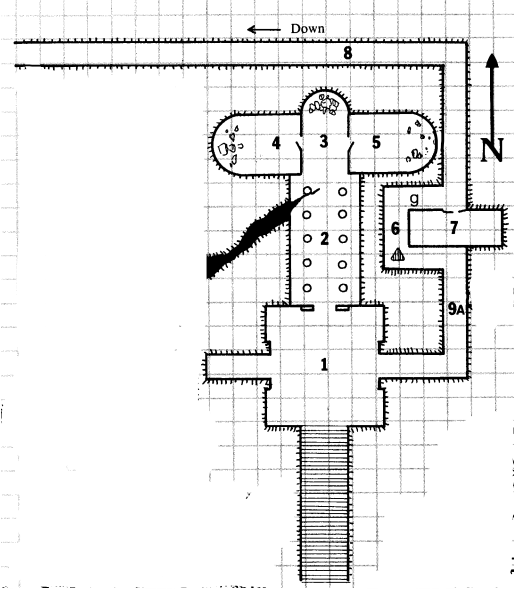
The second floor gets into obvious, non-hidden loops much faster, providing a ramp up of pathing choices after this comparatively linear preamble, which I think works well enough to justify the possibility of the first floor being so (seemingly) tiny. And of course once the player starts exploring the second floor, they’re going to see the big vertical shafts that lead up to sections of the first floor they didn’t cross the secret doors at 8 or 9A to see. It’s a bold choice to lock so much of the this part of the dungeon away behind secret doors, but I think it works because 1) it’s such a huge portion of the first floor that I think it begs the player to ask “am I missing something?” and inspect further, 2) it stays true to the internal logic of how these two warring factions can exist within such close quarters, and 3) the players are going to figure it out pretty quickly once they start exploring the second floor.
Vertical Interactions on the First Floor
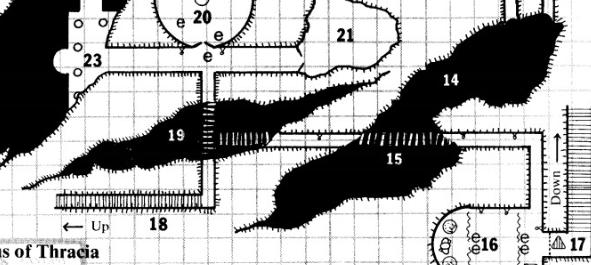
The black areas on the map mark different kinds of vertical interactions. For example, #15 is a pit, but #14 is actually a rocky cliff coming up from B2F. So not only are there multiple paths to each quadrant of the dungeon, but the paths themselves can branch to entirely different floors via climbing.
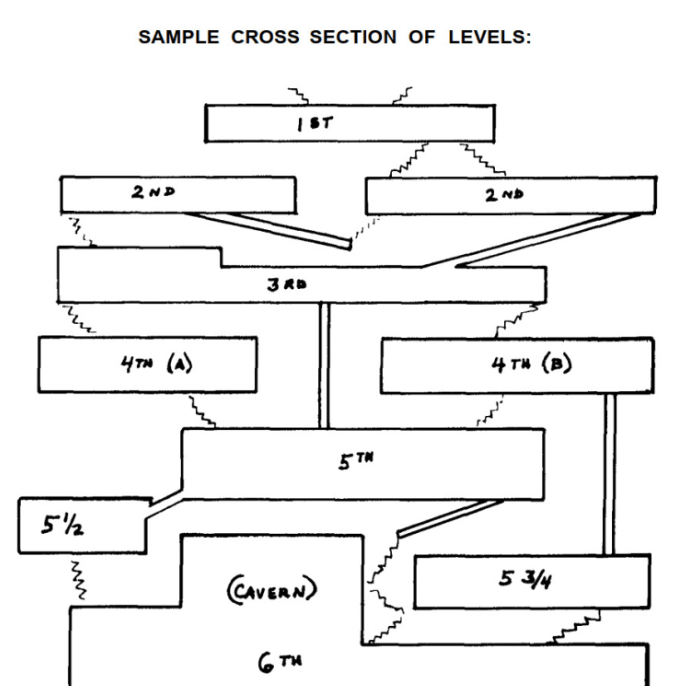
Remember this bit from The Underworld and Wilderness Adventures in OD&D, where Gygax proposes multiple means of ingress and egress between the different dungeon levels?
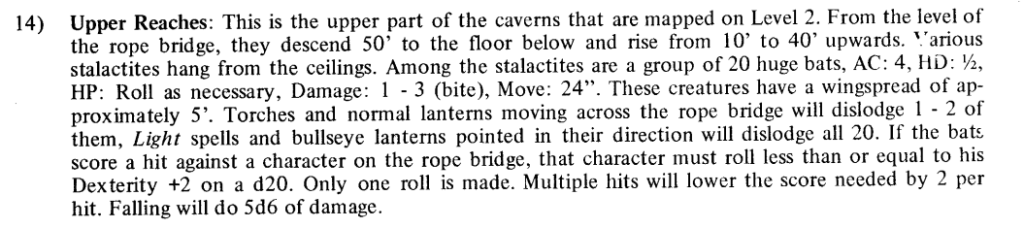
Well #14 gives us a concrete example of this in a written adventure, and a pretty interesting one to boot. Taking a look at the key below, we can see that using light while taking this shortcut risks attracting the giant bats in the middle of the climb downward. Another tempting pathway that carries some unique risks. From a more sensory perspective, I love that it also breaks up the environment you’re exploring, as you’re using this rocky, cavernous environment as liminal space to move between two artificial structures (the temples on floors 1 and 2).
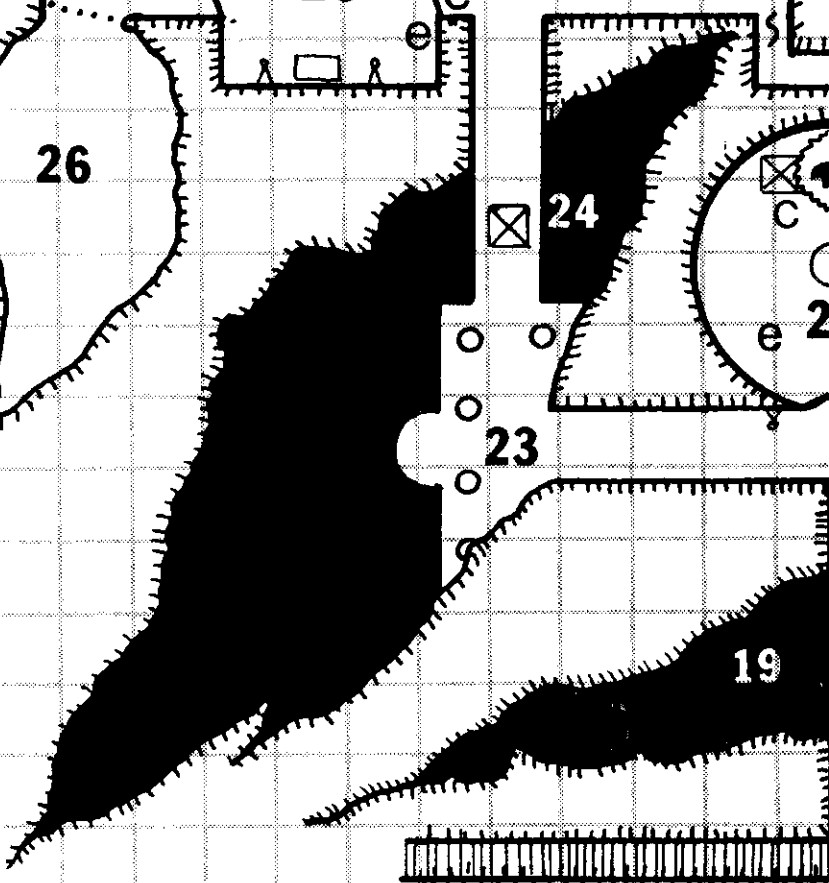
Speaking of vertical interaction, #23 is the place that the super secret entrance on the surface leads to:
It uses the fact that it’s a secret entrance as part of the logic of the room, as the shaft that lets in sunlight shines it directly onto the altar described in the key:
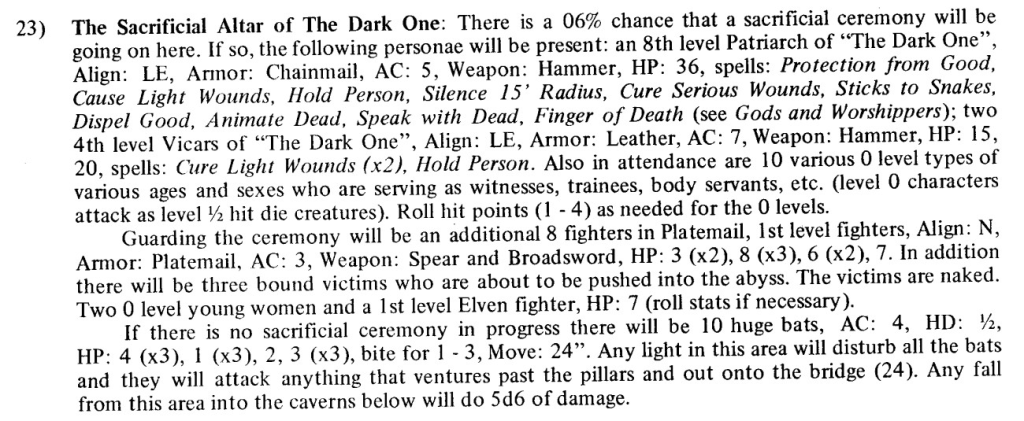
This is one of the few rooms that has natural lighting, which acts as a hint to draw the players’ attention to the shortcut. This is kind of an ongoing theme in this dungeon: certain characters or monsters will be looking for unnatural light, so the players always need to be thinking about whether their lanterns or torches are lit. I like that the room that draws the most attention to this is also one that rewards players for actually thinking about what it means that there’s natural light there.
You can see how this one structural detail — a hole in the ceiling letting in natural light — is actually doing work for setting up the logic of the environment that the players will later be expected to internalize and exploit. Jaquays is trying to sell you on the idea that this dungeon design is laying down an internally consistent framework that has more payoffs than one you might just roll randomly or draw haphazardly. One doesn’t need to design a space with this level of sophistication to have fun with D&D, but if you decide to outsource this work to Jaquays, she hella rewards you for it.
One more thing about this area before we move on. Right next to this room, in #24, we have a trap door that leads to a pool of water on the second floor. While this is not something you’d want to fall victim to, players who discover this could conceivably use rope to create a second shortcut right next to the one from the surface. In other words, some smart play could create a shortcut from the surface almost directly to the second floor.
Let’s look at the other secret entrance to the dungeon, located in Area #18.
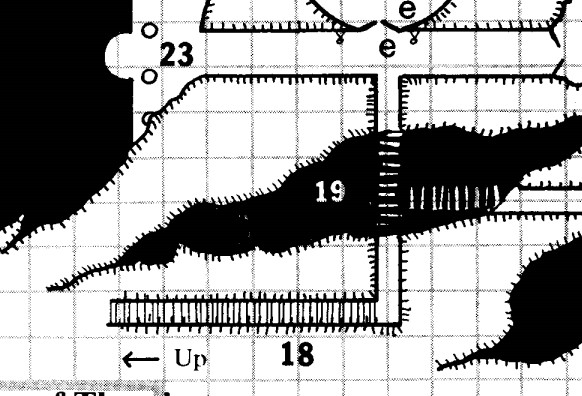
It’s not particularly hidden when approaching it from the inside of the dungeon, though it is dangerous to get to. If the players decide to take that perilous bridge to see what’s across it, they likely get to leave with all their loot while possibly fleeing any tailing encounters. A tactical consideration for the party’s exit from the dungeon and a cool discovery that will affect their next trip in.
By the way, adventurers coming back in through this secret entrance have a surprise waiting for them that interacts with the surrounding rooms:

Remember my note before about how unnatural light is a running theme on this floor? Well this is a dangerous example of it, one that primes players to think about sightlines. It relies on the fact that the bottom of the stairway from this secret entrance is visible to someone standing on the opposite side of the hallway it connects to:
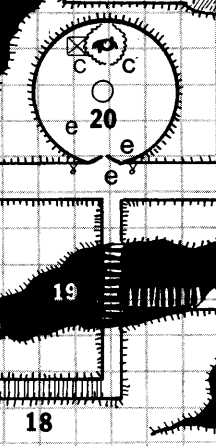
It’s a great example of just how cohesive this dungeon is even on a small scale. Rooms interact with each other both spatially and substantively, and the key provides strong guidance on why it should matter that spot X is visible from spot Y in a different room. Using the interaction between locations 18 and 20 as an example, a new GM could probably figure out how to do a lot more of this kind of thing with either the existing keys or any random encounters they roll, encouraging a style of play where the players must stay aware of the space as a whole, rather than just one room at a time.
Beyond the First Floor
So as promised, we’re going to zoom back out to talk about how the rest of the dungeon iterates on the ideas above. Taking a look at the second floor, we can see that it actually has stronger, less hidden loops than the first one, which serves two very useful purposes: 1) it raises the number of obvious pathing options players will choose from at each intersection, raising the difficulty of navigation a bit while also giving players clearer agency, and 2) it supports the logic of the narrative presented to the players so far, as this level is primarily controlled by the beastmen rather than split with the human cultists.
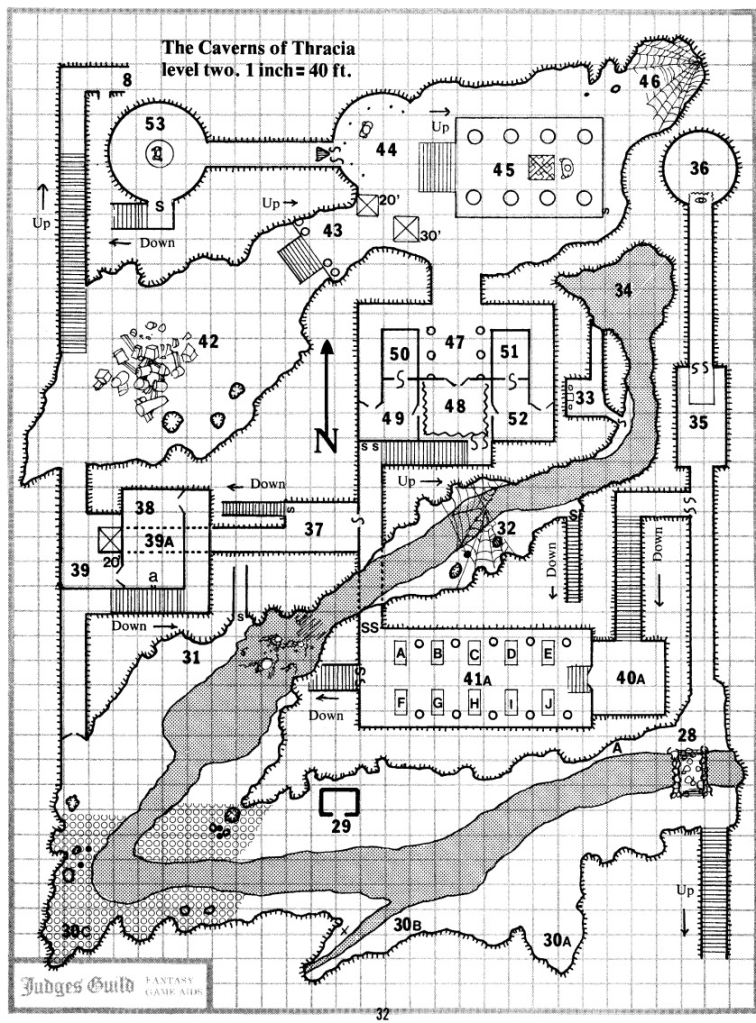
One thing I really like about this level is how it uses the dead ends as their own kind of statement. For example, room 36 is a long detour with no loop back around to the main area because it’s a huge treasure hoard with a memorable and climactic encounter. It makes sense both from a narrative and gameplay point of view as it’s got no easy return to an exit and it’s something the players have to work pretty hard to reach, as one of the paths is barred by a secret door and the other is a long, winding one that will pass a gauntlet of enemies on the south side of the map.
After level 2, we zoom out to something like the Underworld and Wilderness cross section we looked at earlier, where Jaquays shows us what the third floor’s spatial relationship is to the other two.
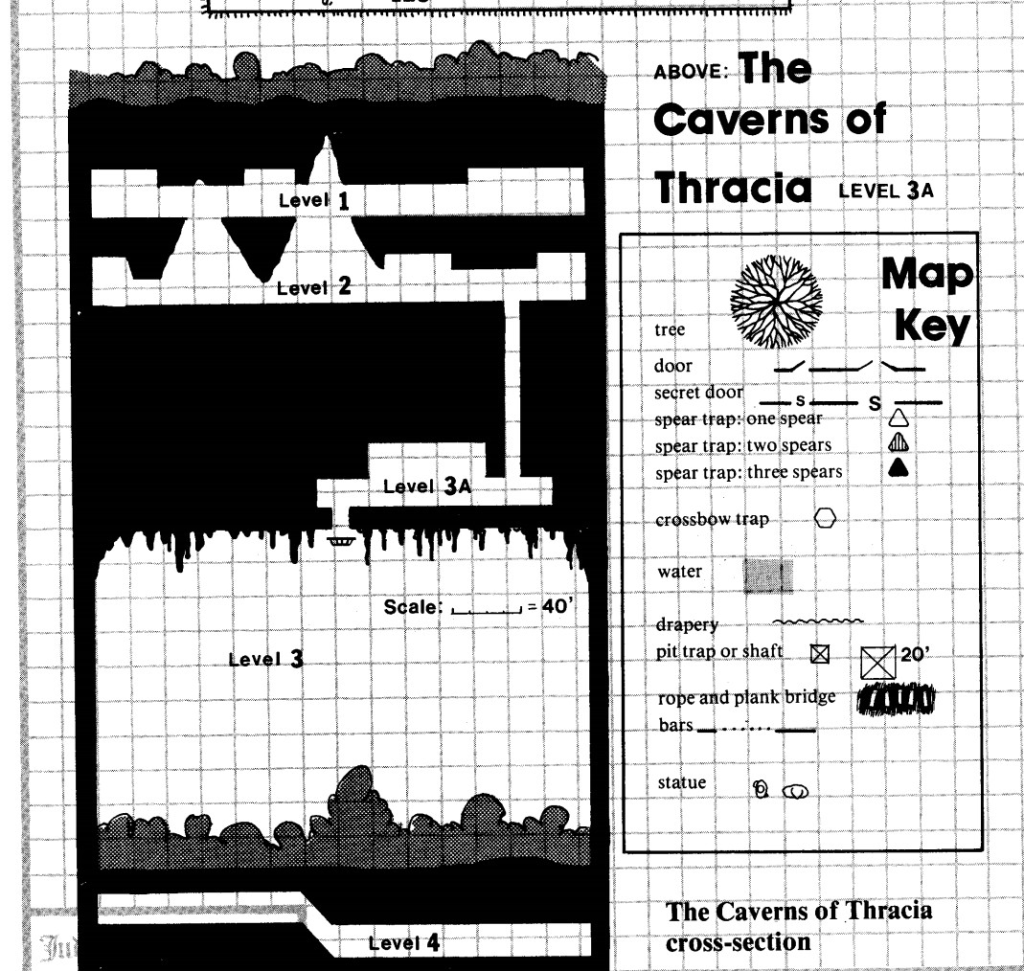
There’s a good reason for this, as the rules of this dungeon change drastically from here on out. Level 3A is a small 9 room dungeon with only one creature (a wandering animated statue of Thanatos), the entrance to which is a tomb on the second floor that is isolated from the rest via secret doors on all sides. Once you step into that area, you’re going where no human has gone in a long, long time. The image above makes it clear that the portion of Thracia that the humans and beast men are fighting over is basically the tip of the iceberg in terms of what the players can discover here. In fact, I daresay it would not strike a modern player as unusual at all that the dungeon would “end”, insofar as dungeons ever end, with the big treasure hoard on the second floor. But Jaquays goes further than that.
Once you get to the bottom of that huge gap below floor 3A, you see that the actual Floor 3 is a massive, magically sunlit underground cavern with its own dungeon that there also multiple entrances to. Jesus Christ Jennell, you didn’t have to go this hard!
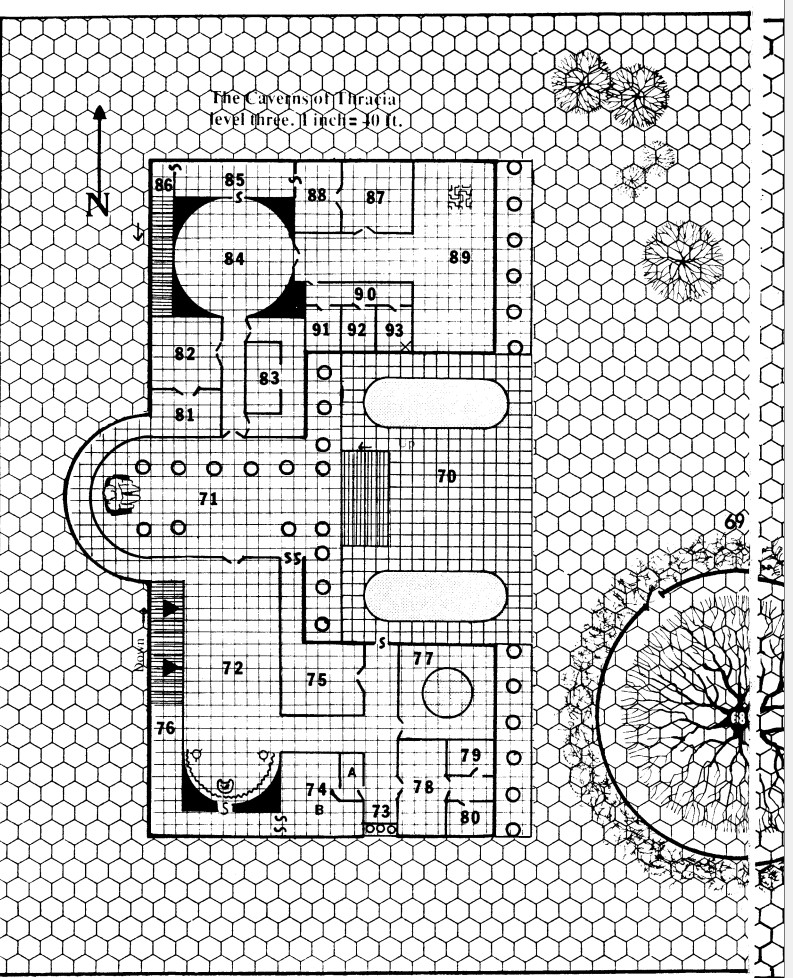
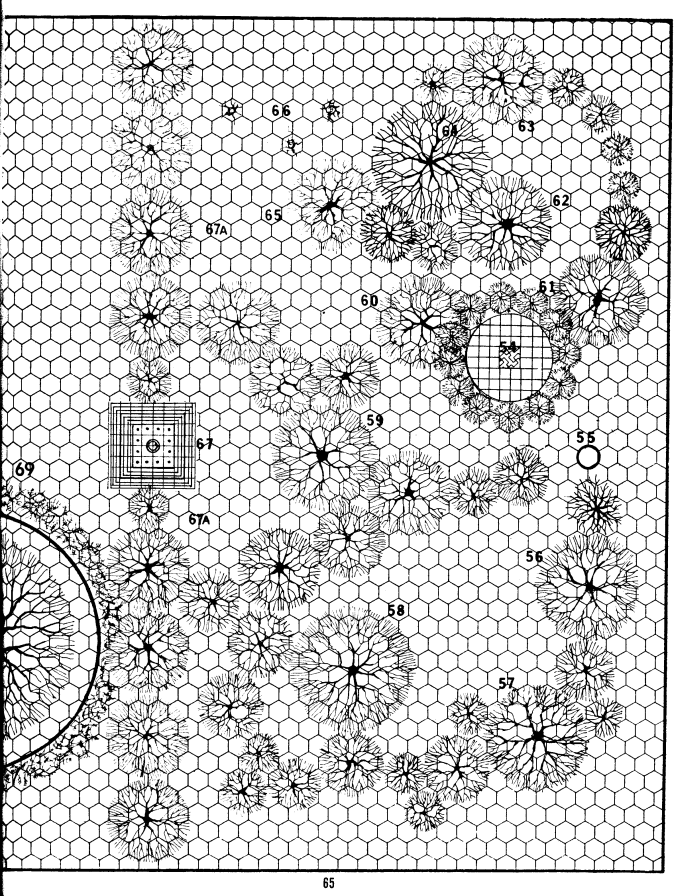
As you might guess, the pace of this area is more akin to exploring the ruins of the city on the surface. There are patrolling beastmen, but a slight majority of the encounters here are humans, cattle or peaceful-ish dryads. There’s no need for the party to advertise their existence with lanterns and torches and there are a lot of places to hide, so players should be able to evade dangerous encounters a bit more easily. There’s also a place where the players can refill their rations and water, and potentially teleport up to the second floor:
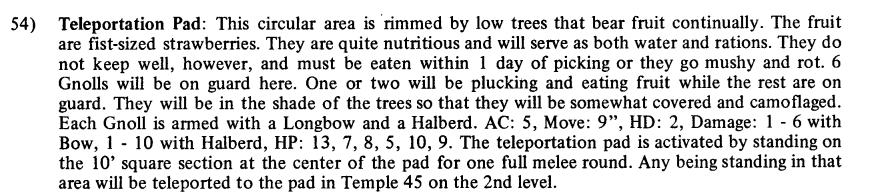
At the risk of sounding extremely nerdy in the middle of this analysis of a Dungeons & Dragons module, there is a bit of a kishoutenketsu feel to how this third level changes the game. The first level introduces us to the basics of Thracia’s design, the second expands on it and gives the players more interesting pathing choices and greater danger, and this third level turns everything on its head with its massive outdoor area. Finally, we get to the fourth part, the actual palace of the Minotaur King who was elected(?) as ruler of all of the beast men of Thracia after they overthrew the ancient Thracian king, which is itself a two floor dungeon that follows a similar design sensibility to what is seen in the first two floors, including a shortcut all the way back to the second floor.
An interesting design choice here, by the way, is the use of human slaves by the Minotaur King and his followers. As uncomfortable as this subject matter is, it does solve some logistical problems for the module as a whole. Besides being an obvious set of stakes for the adventure (I’m assuming most players would want to free them, or at the very least not become them), they’re also a likely avenue for communication with the beastmen. Most of the language used this low in the dungeon appears to be either Thracian, Gnollic, Minotaur or Tribesmen, and the players can only learn Thracian or Tribesmen from the rumor table (though I’m sure players will start studying Gnoll at some point if this dungeon is the center piece of the campaign). Since the human slaves can be found doing various tasks at the palace, it preserves some non-combat interactivity for parties consisting mostly of humans, elves, dwarves, etc. Not all of the humans are eager to escape, either. Here’s an example of a beastmen-aligned human slave:
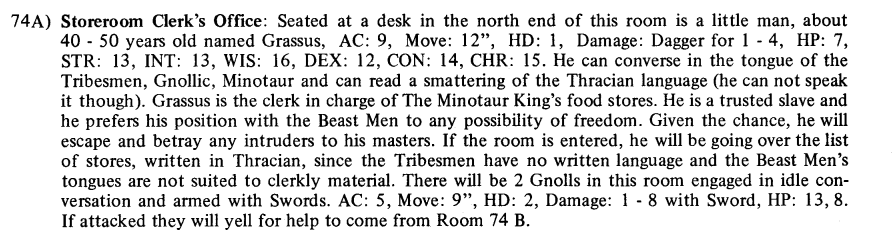
It’s a small thing, but I appreciate that Jaquays kept this human element in mind for even the lowest depths of the dungeon. I like that even this far down, the players will be able to interact with a reminder of the surface world, possibly even characters they could rescue.
What We’ve Learned
Hopefully by this point it’s clear why this module and its author are a big deal, and why Jaquays’s incredible sense for level design changed what we could expect from pre-written dungeons. There are a lot of good lessons that a prospective dungeon writer can take from The Caverns of Thracia, far more than what I’ve discussed in these last two posts. Still, here are eight level design ideas that I think are particularly valuable to learn from this module, which you’ll probably recognize as now very common dungeon design advice:
- Looping paths: These accomplish more than just that Dark Souls style satisfaction of opening shortcuts and finding yourself in a familiar place. Loops in dungeon paths are a key enabler of player agency, as they allow players both to choose between two obstacles without later being forced to do the one they ignored (because the loop will let them eventually see what’s behind that obstacle), and also to approach a single obstacle from two directions.
- Material differences between paths: This is why the choices in Thracia feel more meaningful than choosing between a series of doors along a hallway. If one path has nonstandard movement, and another has an enemy patrol, the players get to pick between two kinds of challenges that will test their skills or tax their resources in two different ways. If the choices are not appreciably different to the players, or if the players have no way to gauge what kinds of challenges lay behind either path, it makes the choice less meaningful.
- Multiple entrances to the dungeon: This is really just a restatement of #1, but it’s worth separating out because it plays into the “strategy” layer, so to speak. It means that the players get to make routing decisions on a macro scale, deciding how they’ll enter and exit the dungeon based on their ultimate goals. For example, players looking to cart out large quantities of treasure on wheelbarrows will probably not exit Thracia through the secret hole in the ground, unless they have some means of levitating their carts.
- Internal logic: Ultimately you want there to be a reason for the GM to use your module over just clicking “generate” on donjon or something like that. The point of an authored dungeon is that the author gets to create connections between things that are very far apart, causing the dungeon to feel like a place rather than a collection of challenges. It also means that the order that players tackle the rooms matter; if room A and B contain people or objects with some relationship to each other, then visiting A->B rather than B->A could conceivably result in very different experiences.
- Difficulty hot spots: Again, this plays into actually meaningful pathing choices. If every area of the dungeon is equally challenging (even if they’re challenging in different ways), it flattens the quality of choice. If instead there are more desirable rooms to enter, players will have small goals in their routing. For example, if players anticipate that they’ll have to flee the encounter found in a given room, they can plan their escape route to take them through a safer area. This bit of planning becomes less meaningful if every room and every path is equally dangerous. In fact, Jaquays extolls the virtue of having empty rooms in one of the room keys (room 85)!
- Landmarks: Compared to stuff like Tegel Manor or Palace of the Vampire Queen, Thracia has big “set pieces” or extremely obvious geographic quirks that, even if no direct interactions is had with them, make it easier to remember where certain encounters or treasure are, and aid the party in drawing their own map. On a less concrete level, I think having the way Jaquays breaks up the geography of the dungeon is also just more emotionally satisfying. Go for varied, memorable geography unless you’re intentionally seeking a kind of Backrooms or House of Leaves sort of experience. Plus, even if you don’t write it in the key specifically, at some point those different geographical shapes are going to come up in play.
- Factional Play: Putting aside the obvious variety that factions bring to the kinds of play the table can experience (opportunities for negotiation, roleplaying, whatever), factions also affect your level design. If factions each have their own corners of the dungeon, and the players have different relationships with those factions, that will affect what the difficulty “hot spots” are and, again, change how players choose paths.
- Verticality: This is kind of a variation on 1 and 3, but dungeon levels can have a similar relationship with each other that the overworld has to the dungeon (i.e. multiple ways to get there, pathing that might start on level 1, go to level 2, then back to level 1, etc.). Also, it can potentially make it possible for an encounter to be interacted with from two different floors.
And that’s it for this post. Again, there is no way I could describe every cool thing about Thracia without basically posting the entire book, and even then you’d be missing out on the magic of actually running it. Not to mention that my analytical skills are definitely not up to the task of conveying everything that made this woman so incredibly good at level design. Jennell Jaquays is the fucking GOAT. Read her books. The end. 
Further Reading
Ok, I lied. I have just a little more for you. If you’re interested in Thracia or Jaquays herself, consider the following:
- A few other articles in memoriam of Jaquays, talking more broadly about her works. Also her obituary.
- Some of Jaquays’s work, including The Caverns of Thracia, have been reprinted by Goodman Games. I’m not sure what the best place to buy these currently is, though print copies of this and The Dark Tower seem to still be available at various online retailers.
- Gus L.’s review of Thracia at Bones of Contention: Gus is a seasoned adventure writer and OSR blogger, and frankly you probably should have just read his review instead of this. Sorry everyone!
- Chris P. Wolf’s “Thursdays in Thracia” series contains session reports from his Thracia campaign using D&D B/X rules. You might need to google to find all the parts as I think they might be hosted across a couple different blogs.
- Justin Alexander used Thracia for his “by the book” OD&D session and provided a session write up. And of course this dungeon played heavily into his original article about “Jaquaying[sic] the dungeon”
- Fire Emblem: Thracia 776: Actually, I’m not sure why I included this one. Maybe to see if anyone is still reading.
- A cool picture of a tricycle. Overhead shot.


You were right, that is a pretty cool picture of a tricycle.
Thank you for this essay, your deep dive was done incredibly and I throughly enjoyed reading it.
LikeLike
Pingback: How Jennell Jaquays Evolved Dungeon Design, Part 1: Pre-Jaquays Dungeons – Pathika